

Do Junior Golfers Need Long Irons?

Should Junior Golfers Use Long Irons? By All Kids Golf Clubs
Since the game of golf was invented around 1860 in Scotland, golf equipment has been evolving and improving. From gutta percha golf balls and wooden clubs to high tech polymer balls, graphite shafts, steel shafts and titanium clubheads, technology has come a long way. These improvements in equipment have made the game easier to play and have led to more people playing and enjoying the game.
But what about kids? They too have benefited from advancements in golf equipment, from lighter and more forgiving clubheads to smaller, lighter, easier to grip shafts. This has led to more kids playing the game today than ever before.
For decades, the only equipment choice for kids was to use standard adult clubs that parents or club makers simply sawed off and re-gripped. While this enabled junior golfers to swing a club, there was no accepted standard for the length of junior golf clubs, until 1999 when we at AllKidsGolfClubs.com published our Sizing Chart, recommending the proper length junior golf club based on the child’s wrist to floor measurement. This information, combined with shaft flex improvements by manufacturers, has led to golf clubs much more suited to younger players.
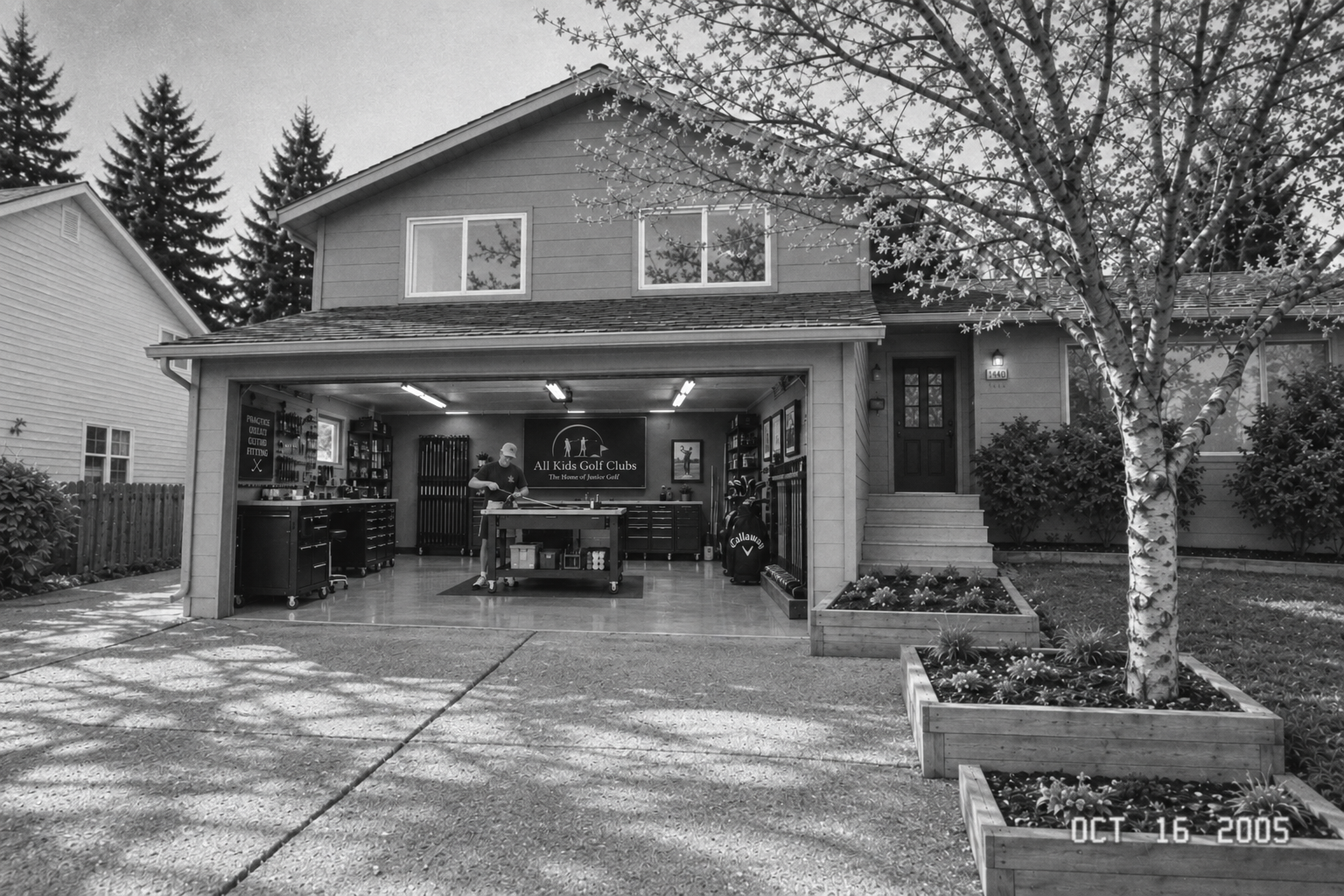
Below in this photo is our founder custom building kids clubs right in his garage, around October 2005. We are in good company, as he is also working with us on writing this guide.
How New Technology has changed Junior Clubs
Now that the size and construction of junior golf clubs is well established, what set makeup would be most beneficial to junior golfers? The typical set makeup for beginner adult golfers consists of Driver, 3 Wood, 5 Hybrid, 6-9 Irons, Pitching Wedge, Sand Wedge and Putter.
Today, when people are using the term “long irons” they are referring to 2, 3, 4, and 5 irons. Notice the absence of these irons in beginner adult sets? In fact, most adult sets do not contain long irons. It makes sense to look at the typical beginner adult set (mentioned above) and apply the same concepts to set makeup for juniors.
Long irons are not included in most golf sets today because they are hard to hit, period. Why are they hard to hit? The reasons include longer shaft, smaller sweet spot, less forgiveness on off-center hits and smaller face. Hybrid clubs have replaced long irons to remedy these problems, improving consistency and accuracy. If your teen is a very skilled golfer, has no problem being consistent with their current irons, explore our options in our Teen Golf Clubs page.
Here’s summary of the characteristics of long irons and hybrids.
What Long Irons consist of:
- Lower Loft: Long irons have the lowest loft angles in the iron category, often ranging from about 12 to 24 degrees
- Longer Shafts: Long irons feature the longest shafts among irons, which helps generate higher clubhead speed
- Lower Trajectory: Long irons produce a lower, more penetrating ball flight designed for maximum distance (typically 170 to 260 yards for adults, depending on the club and swing)
What Hybrid Clubs consist of:
- Benefits of both: Hybrid clubs combine the distance and high launch of a fairway wood with the control and shorter shaft of an iron, making them much easier to hit than hard-to-control long irons
- Center of gravity: Hybrid clubs have a wider, rounded sole and a lower center of gravity which helps get the ball airborne quickly while keeping shots straighter on off-center hits
- Trouble friendly: The curved, smooth bottom of a Hybrid club glides easily through thick grass where traditional irons and fairway woods tend to get stuck
- Gap filler: Many players carry both a 3-wood or 5-wood for distance and a Hybrid for trouble shots and those demanding a higher level of accuracy
What about Fairway Woods? Are they being replaced by Hybrids? Today most beginner adult sets include a 3 Wood, 5 Wood and 5 Hybrid (which is normally about 2 inches shorter than the 5 Wood). Technology has evolved in both Fairway Woods and Hybrids - club weight has been moved around and optimized for maximum forgiveness and optimal ball flight in both.
In general, Hybrids fly higher and Fairway Woods travel farther, and Hybrids are more effective when hitting from taller grass.
Characteristics of Fairway Woods:
- Distance: Longer shafts and lower lofts help the ball fly farther.
- Swing style: Best used with a sweeping motion off clean turf or tees.
- Roll out: Produces a lower landing angle that rolls further upon impact.
- Drawbacks: Larger heads can be hard to hit from tight lies or thick grass.
In general, a typical strategy for a young 7-year-old golfer is to tee off with a Driver, hit a Hybrid from the fairway, and play irons into the green. A example of this type of club set can be found in Cleveland’s CGJ 7 Clubs Set for Ages 10-12. Even if you're looking at one of the best selling teen sets on the market, which would be the Callaway XT Teen Golf Set, it does not come with a long iron. It has a 6-SW for irons.
In summary, long irons are now rare and practically obsolete for most recreational golfers. Most players replace traditional long irons with Fairway woods and/or Hybrid clubs because they offer easier launch, more forgiveness, and more importantly, more fun playing the great game of golf!

Expert Golf Guide
-

Which Callaway Womens Strata Set Should I Get?
Oct 12, 2026Selecting The Proper Callaway Women’s Strata Set by All Kids Golf Clubs Callaway Golf is now offerin
-

Callaway Teen Set vs US Kids Teen Golf Set Comparison Guide
Oct 06, 2026Callaway Teen Set vs US Kids Teen Golf Set Comparison Guide by All Kids Golf Clubs The new Callaway
-

Comparing Callaway Strata Mens Sets
Sep 29, 2026Comparing The Entire Line of Callaway Strata Mens Sets - by AllKidsGolfClubs Callaway Strata Men’s G